Showing posts with label root canal treatment. Show all posts

Friday, 6 January 2017

Toothache hurts so much.......Reason and Remedies ???

Whether you are experiencing a toothache now, have experienced a toothache in the past or are hoping to avoid a toothache in the future, your teeth will benefit very much from a routine of good dental hygiene and regular check-ups at the dentist or dental hygienist.


It has been said that a toothache is the most intense pain that can be experienced. Surprisingly, Teeth only feel pain. There are no other tooth feelings. If a nerve happens to be exposed in there, everything is pain. Cold is pain. Warm is pain. Wet is pain. Touch is pain. There's just nothing else and that's a pretty unique situation in the human body. In fact, a really bad toothache can feel like your head is exploding.

Why toothache is extremely painful?

The face and head, including your teeth, are richly served by the nervous system and make for an exquisitely sensitive and responsive anatomic region.


The mouth and jaw are hooked directly to the trigeminal nerve, which is one of several cranial nerves: nerves that link directly to the brain rather than link to the spinal cord. So, teeth are linked up to a nervous short-circuit of sorts. ​Additionally, your teeth have an abundance of neural connections to the pain centers in the brain. This seems to amplify the noxious “distress signals.”

Why a toothache hurts so bad


When your finger is infected, it normally swells up because of your body’s own immune response. This is possible because the tissues in your finger are relatively soft and flexible. When you have an infection in a tooth, the immune response is the same – but a tooth cannot swell up the same way as a finger can. The infection is caught inside the hard tissues of the tooth, causing a very large pressure. This is the reason for the intense toothache. When the pressure gets too high, the infection will start to work it’s way out of the tooth through the root and into the surrounding bone structure. From here it will continue to push it’s way out through the hard tissues. At this point the toothache is especially painful. Eventually you might develop an abscess, which can normally be seen in the mouth around the area of the root of the tooth which is infected. Sometimes the abscess is even outside the mouth under the chin.

When the abscess bursts, the pressure is off and many people feel an instant relief from the toothache. This does not mean that the problem is solved, however. The reason for the toothache - the infection - is still there and treatment is necessary.

What can be done about a toothache?


There are only two ways of treating an infected tooth effectively. The simple solution is to pull out the tooth but ideally it’s not advisable if you have restorable tooth. Since most people feel that it is best to keep their teeth as long as possible, however, the more common and preferred treatment - when possible - is root canal therapy. There may be a need to combine the treatment with medication to control the infection.

Tuesday, 22 November 2016

Art of restoring a badly decayed/fractured teeth


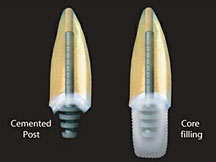
A post and core is a prosthetic device that is recommended when there is inadequate tooth structure remaining to support a traditional restoration or an artificial crown.
Post and core procedure is painless and does not even require local anesthesia as the tooth has long been dead after the root canal treatment. A post and core can only be made for a tooth that has had root canal treatment.
Some posts are ready made, whereas others are made in the laboratory especially to fit the tooth.

Why are post and cores needed ?

A great deal of dental crown stability depends on the amount of tooth structure that extends into its interior. If very little tooth structure occupies this space, the crown will be easily dislodged, especially by forces directed at its side.
Basically, the core is rebuilding the tooth so it is closer to its original dimensions. Hence, the crown's stability will greatly increase, and therefore its long-term chances for success are maximized.
                                              

Is a post always needed ?

A dental post is generally recognized as just an aid in helping to anchor a dental core to a tooth.
As a rule of thumb, if more than half of a tooth's original crown portion has been lost, a post is needed to assist in anchoring the core to the tooth. If more than half still remains, a core by itself (which basically means a direct build up with composite materials) will probably suffice.


Factors to be considered in making the decision to use a post
Many have stated that the main reason for placing a post is to strengthen the connection between the coronal build-up material and remaining tooth structure to the root portion of the tooth. In my opinion, that is only partially true. Additionally, the following potentially negative or positive factors should be considered in the decision to use a post. All of these factors should be observed before making the decision:


• Quantity of remaining tooth structure
• Quality of remaining tooth structure
• Remaining adjacent teeth
• Occlusion
• Planned restoration to be placed on the tooth

When is a post and core not indicated ?

There are certain conditions that make the use of a post and core device inadvisable :
·         Intense pain, gingival bleeding, suppuration, advance infections, tooth abscesses etc. These situations will be evaluated on a case-by-case basis and the post and core should be placed with the greatest caution.
·         Tooth shows advance mobility. Mobility is an indicator of bone loss around the tooth and it should be evaluated on a dental X-ray as well.
·         When the tooth crown is severely damaged (especially when the tooth is fractured bellow the gumline) and the remaining part of the tooth is not strong enough to support the post.
                                              

Structure

A post and core consists of two parts :

·         The post

The post is a small rod, usually metal/carbon fiber, which is inserted into the root space of the tooth and protrudes from the root a couple of millimetres. The post is then used to hold the core, or a filling in place.
Because the post is inserted into the root canal, a post and core can only be made for a tooth that has had root canal treatment.


·         The core

The core replaces missing tooth structure in preparation for making a new dental crown. Normally, a dental core can be directly built up from composite materials without a post to hold it in place.
However, a dental post can be used to help to anchor the core to the tooth. In this case, the core is generally made off metal alloys and the device is called post and core.
The core is then utilized to hold a dental crown in place. The crown can be a single unit crown or a retainer crown for a dental bridge.


Success rates
The procedure is successful in over 90% of cases.
Potential risks
·         Tooth fracture
·         Root fracture
·         Root canal failure (it is difficult to repeat root canal treatment once the post is in place)
·         Post coming out
·         Post protruding through the side of the root (this is a particular risk if the root is curved)

After Dental Post And Core


Post procedure care                                                       
Patients should avoid eating on the crown, following a post and core procedure. Certain foods, such as hard or chewy sweets, should be avoided as the crown could become loose.
Possible discomfort
Some minor discomfort to be expected after this procedure, but this can be easily controlled with normal painkillers.

Tuesday, 18 October 2016

Dental Crown a ..life line...for root canal treated teeth

Root canal is one of the advanced and revolutionary treatments in dentistry to save infected and badly decayed natural tooth. The term “root canal” comes from cleaning of the canals inside the tooth’s root after the removal of infected pulp and followed by disinfecting and filling tooth roots. Once the dentist has an access to the tooth’s roots, the infected dental pulp is removed and the roots are treated with antibiotics.
Why crowns are advised

To better understand the need for dental crowns, it’s necessary to understand why root canal therapy results in large tissue loss
Similar to a cavity filling procedure, tissue is removed from the tooth. This requires the removal of any diseased tissue within and around the cavity. Once a cavity has reached the roots of a tooth, it has usually compromised a relatively large portion of the tooth.


As there is no blood supply, over the time this causes tooth to become brittle and likely to fracture. Permanent fillings after root canals protect the treated teeth from bacteria and to strengthen them in the process but, without the extra protection, which crown provides, there are chances of tooth fracture. Another advantage of crowns is that they restore the natural appearance of your teeth.


Benefits of dental crown


Dental fillings are effective ways of replacing lost tooth tissue. However, they can only fill gaps in a tooth that is otherwise healthy and relatively strong. Root canal therapy tends to weaken a tooth to the point where it shouldn’t be just filled, but also protected on the exterior. More importantly, the dental pulp has been removed, which is responsible for generating new, healthy tissues within a tooth. Consequently, dental crowns are needed for superior restoration.

o    Structural support: Crowns simultaneously fill lost tissue while serving as the tooth’s outer layer. In this way, crowns restore strength to a tooth that would be too weak to function on its own.
o    Protection: By capping the natural crown of a tooth, dental crowns protect a tooth from injury, stress, and abrasion.
o    Preservation: Without a crown, the alternative for many teeth would be extraction and replacement. A crown allows patients to preserve a natural tooth, rather than replace it with a dental implant or bridge.
o     Durability: By using porcelain, dental crowns can easily last 15 years or longer without wear or damage. With the right care, porcelain crowns are effective permanent restorations.  
o    Realistic appearance: Porcelain is the most effective dental material for mimicking the shape and color of natural teeth. And because it’s stain resistant, your porcelain crown will continue to shine for years.


What are the repercussions of waiting?


o    Nothing will happen.
o    The tooth could chip- simple repair. Or it could crack and would need a crown.
o    In rare cases waiting could cause a RE- root canal to be needed.
o    The tooth could split, which could require crown lengthening or extraction.
o    These are things that your dentist should be prepared to talk over with you.

What are the options?

In some cases, while a crown is one option, there can be others. You might opt for a filling instead. Keep in mind, however, that a filling does not prevent you from needing a crown later on. Also, if a substantial portion of your tooth needs filling, a better solution is usually the crown because fillings do not give you the same kind of protection as crowns do. Also, if the filling is extremely large, it can cause the tooth to break, making it irreparable.


Friday, 9 September 2016

Abscessed tooth—A big Headache

Concise View
Dental abscess in a swelling filled with pus, the swelling in your body is result of body’s protective mechanism. It's the mechanism of arresting/preventing debris entering in blood stream from mouth via tooth or gums, a type of protective mechanism. Ideally abscess is caused by body trying to rid its self of harmful bacteria. If you are not suffering from this condition currently, probably you are lucky, still it’s good to be aware of potential consequences so as to keep yourself safe and healthy.


Potential causes of dental abscess 

  • Neglected oral hygiene
  • Decayed tooth
  • Trauma
  • Tooth fracture
  • Left over roots only 

    Abscessed tooth- affecting general health
    Body infection in general is the cause for alarm, as abscess has the tendency to not only locally damage the area but also spread and make condition potentially severe. Reason why tooth infection is different from general body infection:-

    ·        Jaw bone already has compromised blood supply so it limits healing potential by itself.


    ·        With increase in age, healing potential gets delayed.

    ·      If debris from oral cavity is entering gums/carious teeth, then it’s a unilateral entry so chances of abscess being drained down by itself is very limited.


    ·        Presence of abscess will make treatment more time consuming and eventful.


    ·     Treatment line depends on severity of abscess. In extremely severe condition to get an early relief one may have to sacrifice tooth/teeth, which could have been saved if approached to your dentist timely.

    a.      Other most important symptoms present along are
    1.      Fever
    2.      Bitter taste in mouth
    3.      Swollen jaw
    4.      Reddened gums
    5.      Bad breath
    6.      Sleepless nights
    7.      Loosening of tooth
    b.      To be on a serious note, abscessed tooth may lead to heart issues (bacterial endocarditis), full face infection there by restricting airways (Ludwig’s angina), transfer of infection to brain. 
    Treatment alternatives
    a.    Conservative approach – if patient’s condition permits, ROOT CANAL THERAPY, preferably the ideal choice followed by tooth crown/cap.
    b.       Extraction – if tooth is non- restorable or condition becomes severe.


    ** Emergency dental procedure can be costly, but preventative treatment is not

    Sunday, 4 September 2016

    Root canal treatment??....Can that be avoided….A simplified approach.

    Teeth are the hardest part of our body. Significantly, teeth plays a role in chewing (old concept), while the newer concept says that they helps to sense, feel the food which is missing in artificial teeth and essence of teeth is in defining the individual’s personality. Presently, cosmetic and esthetic factor is one of the most prime factors in defining the health of oral cavity.


    Building blocks for teeth are calcium and phosphorous, which are prone to dissolve under acid, formed during the fermentation of stuck up food. Tooth has layered pattern, ‘enamel’ on the top followed by ‘dentin’ and the deepest part being the ‘pulp’. Pulp is a type of tissue with rich supply of blood and nerves. Function of pulp is creating hard tissue of tooth during development, however once tooth is fully matured it can survive without pulp as then tooth continues to be nourished by the surrounding tissues.


    Natural tooth when exposed to prolonged acid attack from dietary sources and stuck up food, there is dissolution of tooth and cavities are formed. It’s recommended to get those cavities filled up as early as possible to avoid large destruction of tooth.

    Stage I- In case of gross destruction of tooth the pulp gets infected with bacteria and all different types of microbes and the oral food taken has the potential role in increasing inflammation.

    Symptom –pain /sensitivity but not continuous


    Stage II- Inflamed pulp with due course of time gets dead and necrotized and pus/abscess is formed.

    Symptom – severe uncontrollable pain with sleepless nights, swelling, if still unattended, fever too.

    So from here doctor is left with 2 options

    1. Tooth extraction – tooth is lost and requires artificial replacement

    2. Root canal treatment/therapy – natural tooth is preserved in an uninfected state- Best option to select from patient’s aspect.

    Saving the natural tooth with root canal treatment has many advantages:

    ·         Efficient chewing
    ·         Normal biting force and sensation
    ·         Natural appearance
    ·         Protects other teeth from excessive wear or strain 

    Prevention

    Initially in a usual course, when tooth erupts, its free from defects like cavity, but it requires time to mature so that it can be resistant to acid attack from different dietary sources. Few easiest ways to get rid of all this mess

    Diet modification – prevent frequent exposure to sweet food and beverages, have your favorite sweets in a single go to your heart’s content.


    Fluoride application—the easiest way to prevent and stop the caries process


    Dental sealants – blocks some of the deep pits and grooves in tooth this no chances of food stuck up.
    Professional cleaning/scaling